What it is
A spiritual path combining yoga, meditation, and the teachings of Paramhansa Yogananda.
A spiritual path that combines yoga, meditation, and the teachings of Paramhansa Yogananda.
At a glance
What it is
A spiritual path combining yoga, meditation, and the teachings of Paramhansa Yogananda.
Why explore it
People explore it for stress relief, inner calm, and a sense of purpose or spiritual direction.
How it’s experienced
Guided meditation, gentle yoga, and talks with a teacher, often in a group or retreat.
Evidence context
Research on Ananda itself is limited. Its yoga and meditation parts have been studied more.
See the evidence snapshotSafety
Generally low risk. Check with a clinician first if you have a serious mental health condition.
See staying safeHistory & Origin
Ananda is a Sanskrit word for bliss or deep inner joy, and in this context it refers to a spiritual path based on the teachings of Paramhansa Yogananda. It brings together yoga, meditation, and devotional study in the Kriya Yoga tradition, with an emphasis on cultivating joy and a sense of connection.
Taking part usually means learning yoga postures, breathing practices, and meditation techniques from a teacher, and studying the philosophy behind them. A first conversation often covers your interests, experience, and goals. Practice is meant to be regular, and many people join classes, retreats, or community gatherings.
People use it to reflect on life purpose, to build a daily meditation routine, to find calm in a busy life, and to feel part of a spiritual community. Practitioners describe the aim as inner joy and balance rather than a specific health outcome.
Evidence for Ananda as a whole rests on tradition and personal accounts, not clinical trials. Its parts, such as yoga, meditation, and slow breathing, have been studied widely and are associated with less stress and better wellbeing for many people, though that research does not test the spiritual teachings themselves.
Check with a doctor before starting if you have physical limitations, or with a mental health professional if you live with psychosis, bipolar disorder, or substance use concerns, since intensive meditation can be difficult at times. Choose a teacher with real training who is open about their lineage and does not pressure you.
Ananda was founded in 1968 by Swami Kriyananda (J. Donald Walters), a direct disciple of the renowned spiritual teacher Paramhansa Yogananda. Yogananda, who arrived in America in 1920, introduced the ancient science of Kriya Yoga to the West and authored the spiritual classic 'Autobiography of a Yogi.' His teachings emphasized the universal principles underlying all religions and the importance of direct personal experience of the Divine.
Swami Kriyananda established Ananda communities initially in California, creating intentional spiritual communities where people could live and practice together according to Yogananda's teachings. The first Ananda community was founded near Nevada City, California, and became a model for simple living, high thinking, and cooperative spiritual life. Kriyananda developed specific meditation techniques, yoga practices, and lifestyle principles that he believed would help people achieve the state of ananda - Sanskrit for 'divine joy' or 'bliss.'
The Ananda path spread internationally through the establishment of communities, centers, and teaching programs in Europe, India, and other parts of the United States. The movement emphasizes practical spirituality that can be integrated into daily life, whether one lives in a spiritual community or in conventional society. Central to Ananda's approach is the practice of Kriya Yoga meditation, devotional practices, and the application of spiritual principles to create harmony in relationships, work, and personal growth.
Mechanism
Ananda combines yoga postures, breathing, meditation, and study of Yogananda's teachings. Research supports some of these parts, not the spiritual framework itself.
Your first visit
A typical session outline to help you feel prepared
Teachers and communities differ, but a first Ananda class or conversation often follows the shape below. You can ask about any step before you join.
The teacher asks about your interest in the path, any meditation or yoga experience, and what you hope to find.
You mention injuries, physical limits, and any mental health history so the practice can be adjusted for you.
The teacher explains the teachings of Paramhansa Yogananda and the idea of cultivating inner joy, with room for your questions.
You try a few postures at your own pace, and you can rest or skip anything that does not feel right.
You are guided through slow breathing and a short seated meditation, usually with a simple focus point.
The session ends with quiet time and an invitation to a regular class or retreat, which you are free to decline.
The evidence
An honest read on how Ananda has been studied — an evidence tier and the research behind it, not a guarantee and not a ranking of “better.”
Rooted in traditional use, with growing research interest
The evidence for Ananda specifically is primarily based on traditional spiritual teachings and practitioner testimonials rather than clinical research studies.
Its parts, such as yoga, meditation, and breathing practices, have been studied more, with reported benefits for stress and wellbeing.
Support comes from studies of its parts, like yoga and meditation, not from trials of Ananda itself.
Safety first
General guidance to help you decide whether this approach is appropriate for you. This is informational only and not a substitute for medical, psychological, or professional advice.
If you are pregnant, managing a health condition, recovering from injury or surgery, or taking medication, consult a qualified healthcare professional first.
Some situations call for extra care or a different approach. Share any conditions, injuries, or sensitivities with your practitioner before your first session.
Look for clear boundaries, transparent pricing, and practitioners who avoid fear-based claims or pressure to book frequent sessions.
Mild, short-lived effects such as tenderness, tiredness, or temporary soreness can occur. Rest, hydrate, and tell your practitioner how you respond.
For you?
A simple, human way to weigh it up. This is general guidance, not personal medical advice — a qualified practitioner can advise on your situation.
Gyfts is a discovery platform, not a medical provider. Nothing here diagnoses, treats or replaces professional care. In an emergency, contact your local emergency number.
In their words
Before you book
FAQ
A typical Ananda session starts with a conversation about your goals, experience, and preferences. Your teacher then guides you through techniques such as yoga postures, breathing practices, or meditation, and may share some of Yogananda's teachings. There is usually time for questions at the end, along with suggestions for practicing on your own between sessions.
The number of sessions varies with your goals, preferences, and how you respond. Some people try a short series and then check in with their teacher about whether to continue, while others settle into a regular practice or join a community class. There is no set number, so you can decide together as you go.
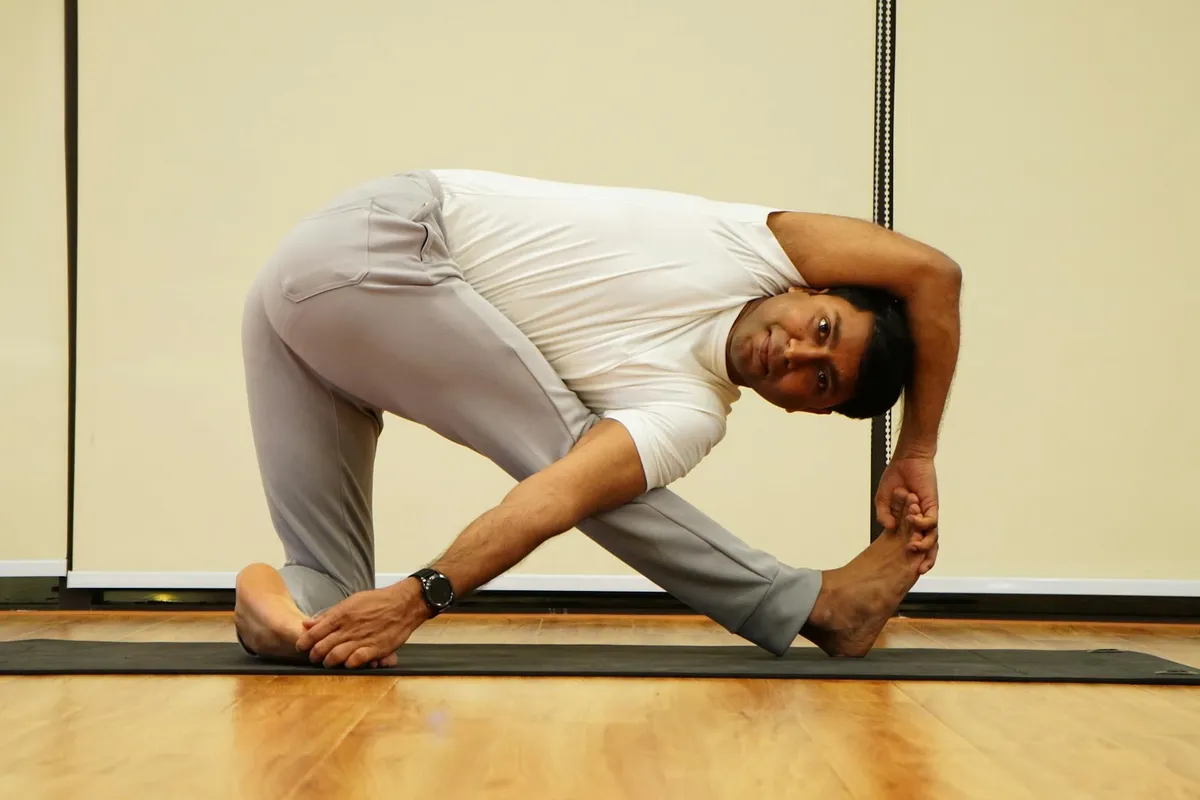
Ananda yoga is a gentle, spiritually-oriented style developed by Swami Kriyananda based on the teachings of Paramhansa Yogananda. It emphasises the use of yoga poses as a preparation for meditation, each posture is held with awareness and accompanied by specific affirmations designed to uplift the corresponding energy in the body and mind. It is one of the quieter, more inward styles of yoga, less physically vigorous than Vinyasa or Ashtanga. It is particularly suited to those drawn to yoga as a spiritual practice rather than primarily a fitness activity, and to beginners seeking a gentle, supported entry into yoga.
The distinguishing feature of Ananda yoga is its integration of energy awareness and affirmation with each posture, the practice is explicitly designed to cultivate the specific energy quality associated with each pose and to use yoga as a systematic path to higher states of consciousness. This contrasts with Restorative yoga (which focuses on parasympathetic nervous system activation through long-held supported poses) or Yin yoga (which targets connective tissue). Ananda yoga is posture-based and active while remaining inward and spiritually intentional.
Ananda yoga sits primarily within a spiritual tradition; its theoretical framework is drawn from Yogananda's teachings on the chakras, energy, and consciousness rather than biomedical research. The general evidence base for yoga (stress reduction, flexibility, mood, chronic pain) applies to gentle yoga practice broadly, including Ananda. The specific affirmation and energy awareness elements are not separately studied. People seeking yoga primarily for clinical health outcomes may find Hatha, Yin, or Yoga Therapy more explicitly evidence-informed; those drawn to yoga as spiritual and meditative practice may find Ananda a deeply meaningful approach.
Keep exploring
Browse practitioners, explore honest overviews, and take what you learn to a conversation — at your own pace.