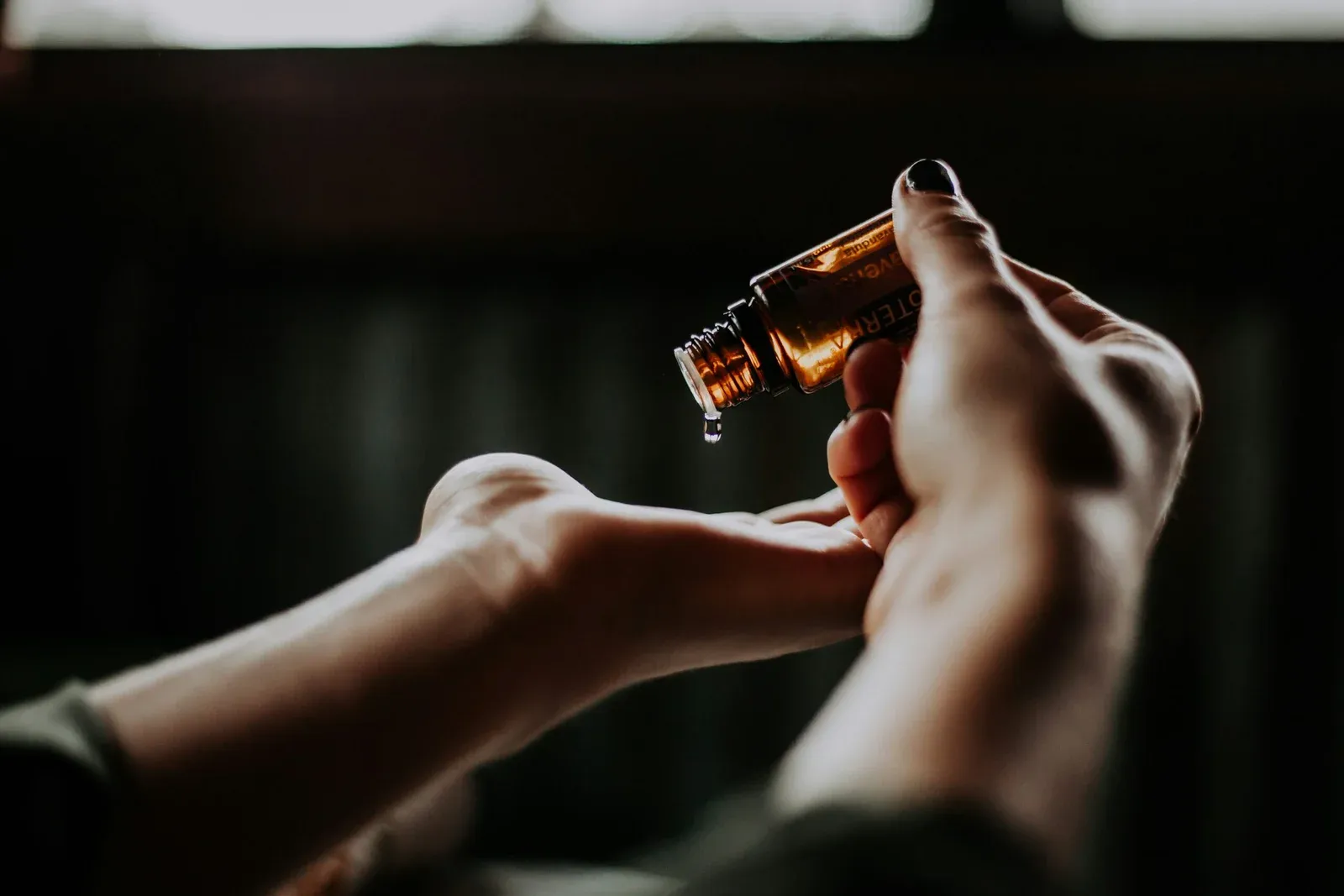
Does aromatherapy help people with cancer? It may ease anxiety, nausea and sleep problems for a while, but most of the research is small, short and at high risk of bias, and the most rigorous review found the evidence too weak to confirm a meaningful clinical benefit. Aromatherapy, the use of plant essential oils by inhalation or in massage, is widely offered in supportive cancer care. This review sets out what the trials measured and found, so you can weigh it calmly. For the practice itself, see the Gyfts aromatherapy guide.
What the studies looked at
The research tests two delivery methods: aromatherapy massage, with essential oils diluted in a carrier oil, and inhalation from a cotton pad, personal inhaler or room diffuser. Participants include people having chemotherapy or radiotherapy, people having breast surgery and people in palliative or hospice care. Outcomes are mostly questionnaire scores for anxiety, depression, pain, nausea and vomiting, sleep, fatigue and quality of life.
The anchor source is a Cochrane review by Shin and colleagues, published in 2016. It included 19 randomized trials with 1,274 participants. Thirteen trials compared massage with no massage, six compared aromatherapy massage with no massage, and two compared massage with and without essential oils. An earlier Cochrane review by Fellowes, Barnes and Wilkinson, published in 2004 and later withdrawn, had found eight trials with 357 participants.
The largest single trial, published in the Journal of Clinical Oncology in 2007, randomized 288 people with cancer and clinical anxiety or depression at four UK cancer centers and a hospice. They received a course of aromatherapy massage plus usual supportive care, or usual care alone.
Since then, several pooled reviews have added newer trials, many using inhalation, ranging up to 26 studies with 2,912 participants (2024). Some focus on radiotherapy or chemotherapy, nausea, or inhaled oils. A small qualitative study interviewed 15 women with cancer in Hong Kong.
What they found
The 2016 Cochrane review is the most cautious. For massage without oils, one trial of 72 people found less short-term pain, but pooled anxiety results from three trials showed no significant difference, and there were no differences in depression, nausea, fatigue or quality of life. For aromatherapy massage against no massage, anxiety scores fell more in two trials with 253 people, and some pain scores improved, but the authors judged these gains unlikely to be clinically significant. Too little data existed to judge whether the oils add anything.
The 2007 trial shows timing most clearly. At 10 weeks, aromatherapy massage gave no significant improvement in clinical anxiety or depression compared with usual care, but it did at 6 weeks, and self-reported anxiety was better at both points. The authors concluded the benefit lasted up to about two weeks after the sessions ended, not long term.
Newer pooled reviews are more positive but disagree. A 2022 review in Frontiers in Public Health found a modest reduction in anxiety (standardized mean difference -0.49) but no effect on depression. A 2022 review in General Hospital Psychiatry reported reductions in anxiety (-0.51) and depression (-0.44), mostly around surgery, with no clear effect during radiotherapy, chemotherapy or palliative care. A 2024 review of people having radiotherapy or chemotherapy found improvements in nausea, vomiting, sleep, pain, fatigue and quality of life, but not anxiety.
For nausea, a 2024 review of randomized trials found aromatherapy reduced nausea (-0.85) but not vomiting alone, with peppermint oil standing out. A 2021 review of inhaled oils found positive results in seven of nine adult studies using direct inhalation, while room diffusion and studies in children showed no benefit. Women in the qualitative study described comfort, relaxation and feeling cared for with dignity.
How strong the evidence is
Not strong. The Cochrane authors downgraded every outcome to very low quality because of imprecision, indirectness, imbalances between groups and weak study design. Fourteen of the 19 trials had a high risk of bias linked to small sample sizes, and 17 did not report adverse events. A 2024 review of people on radiotherapy or chemotherapy found no included trial of high quality.
The newer reviews report larger pooled effects, yet their authors add caveats. The 2022 General Hospital Psychiatry review called its included studies low quality, noted that most compared aromatherapy with usual care, and observed that placebo also appeared effective in some trials. It concluded the literature does not yet support routine clinical use. A 2026 review of essential oils for chemotherapy nausea in breast cancer rated certainty as low for nausea and very low for vomiting.
Two structural problems run through this field. Scent is hard to mask, so participants usually know which group they are in. And when the comparison is usual care, the extra attention, touch and quiet time of a session may explain part of any benefit. The reviews also disagree on which outcomes improve and whether massage or inhalation works better, as small, varied trials tend to.
Limits and open questions
Follow-up is short. Most trials measure symptoms right after sessions or within a few weeks. A 2012 descriptive review concluded there was no long-lasting effect of aromatherapy massage, with short-term improvements reported up to eight weeks after treatment at most.
Trials use many different oils, doses, dilutions and delivery methods, so pooled results blend unlike things. Some groups dominate: the inhaled nausea trials in one review involved mostly women with gynecologic cancers, and others focus only on breast cancer. Whether essential oils add anything beyond massage itself remains unanswered.
Safety reporting is thin. Most trials did not report side effects, so a low reported rate is not the same as a known low rate. The 2012 review listed potential risks including skin irritation, allergic contact dermatitis, reactions to sunlight with some oils and harm from swallowing large amounts. It also noted reversible breast tissue growth in prepubertal boys linked to repeated skin use of lavender and tea tree oils.
What this means in practice
If you are living with cancer and drawn to aromatherapy, think of it as a possible comfort measure with a chance of short-term relief, not a dependable symptom remedy. It should sit alongside anti-nausea medicines, pain management and psychological support, never in place of them. The 2026 breast cancer review said plainly that essential oils should not replace guideline-based anti-nausea therapy.
Tell your oncology team before you start, especially if treatment has left your skin sensitive. If you want touch included, aromatherapy massage is the form tested in the Cochrane review and the largest trial. Aromatherapy is not regulated as a profession in many places, so ask any practitioner about their training and oncology experience. You can search for practitioners in the Gyfts practitioner directory, or browse related approaches through Gyfts explore.